A color grade should let you shape a photograph deliberately. In one Chiado experiment, combining strong tonal colors with global grading also tinted a clipped-white patch. The average comparison score improved, but a basic endpoint had changed.
We changed how the tonal contributions combine and bounded the luminance shifts, then kept the clipped-white probe as a check on the implementation. The revised model preserved the tested black and white endpoints without painting the final white pixel back to white. The subsequently retained working-space revision passed all five synthetic clipped-white comparisons.
Build a scene with a known answer
We made a synthetic RAW with gray stripes and a final stripe whose sensor samples were set to the file's white level. This was a scratch copy; the photographic source remained unchanged. Lightroom exported five corresponding grading variants, including strong combinations. In all five, the clipped patch remained RGB white.
The earlier candidate still tinted that patch in a mixed grade. Its global stage was improved, but the older additive shadow and highlight stages had already changed white before the global adjustment ran.
Fix the composition, then check the assumption
The revised experiment combines tonal color contributions with a soft-light model and applies bounded luminance shifts. It preserves black and white without a special instruction to turn the final white pixel back to white. The synthetic white probe then matched in every tested case.
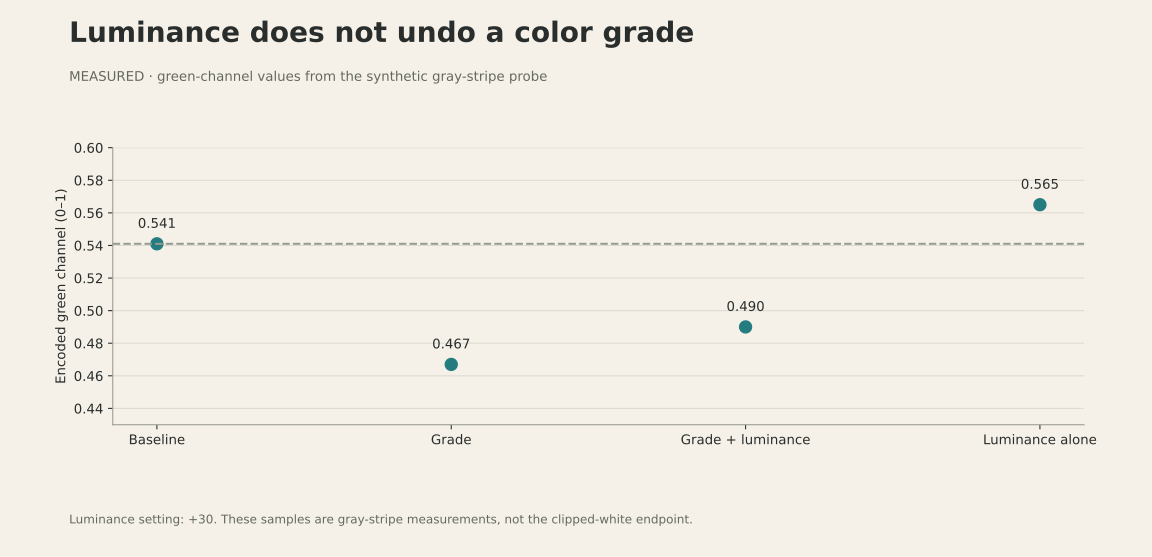
A different assertion failed next. It assumed that raising midtone luminance must bring a strongly tinted gray's green channel above the original gray. A second Lightroom probe showed why that was too strong:
| Setting | Green |
|---|---|
| Baseline | 0.541 |
| Blue shadows and red highlights | 0.467 |
| Same grade, midtone luminance +30 | 0.490 |
| Midtone luminance +30 alone | 0.565 |
The luminance control brightened the tinted patch, but did not erase the tint's effect. These are 8-bit samples of the closest available stripe, not an exact experiment at RGB 0.5. We changed the test to compare the tinted patch before and after the luminance adjustment, while retaining the white checks.
A passing probe is not acceptance
The first full tonal candidate lowered response error by 45.7% over 171 reused development-validation cases, but 42 worsened. That version was not adopted. A subsequent working-space experiment improved the response further and was retained after additional checks, with its remaining regressions documented. The probe established one behavior; it did not settle green and cyan response, tonal blending or photographic appearance.
What this changes for Chiado
The retained grading model addresses an identifiable defect: the tested combinations no longer tint a fully clipped-white patch. It also skips an unnecessary conversion when the tonal operation contributes nothing, avoiding a floating-point endpoint change. These checks protect the extremes of the image; remaining highlight-color and blending differences still need photographic evaluation.