If a green or cyan grade looks weak, turning up its strength is an obvious response. But a different tint may then move the wrong way. Chiado’s earlier grading implementation showed both symptoms, which suggested a problem deeper than the amount slider.
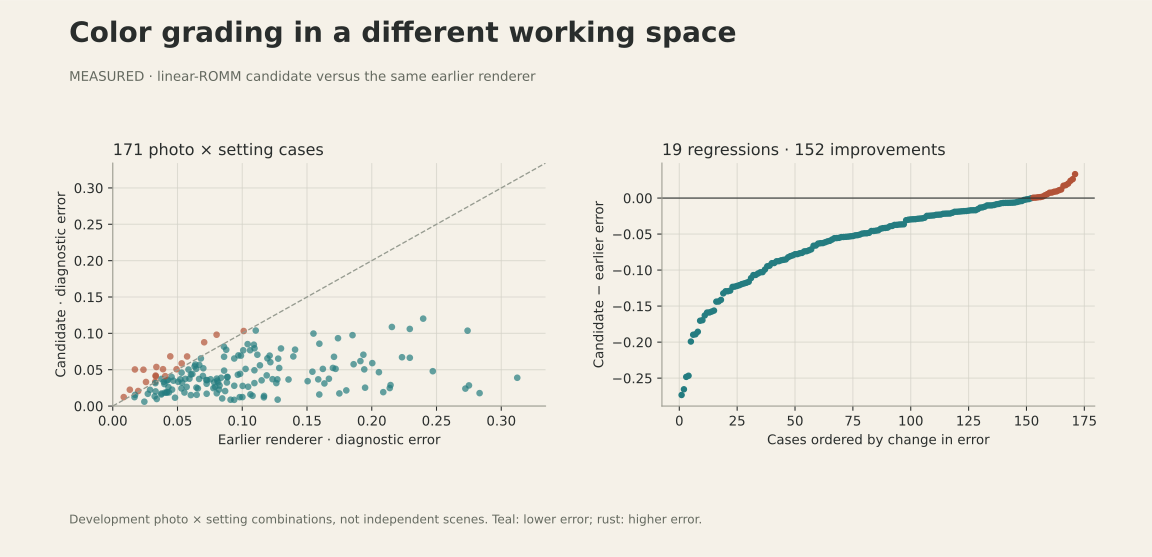
We moved the tonal soft-light calculation into linear ROMM after comparing six RGB representations. The retained implementation strengthened the inspected green and cyan responses and brought the red-shadow example closer to its reference direction. On 171 reused development-validation cases, diagnostic error fell 57.4% relative to the older renderer; regressions fell from 42 in the earlier candidate to 19 in this one.
A formula includes its coordinates
A nonlinear operation on RGB values depends on how those values represent light and color. Performing the same channel calculation in encoded sRGB, linear sRGB or a wider-gamut RGB space need not produce the same result after conversion back.
Our search compared six representations: encoded and linear sRGB, plus ROMM primaries with linear values and three encoding choices. Each used the same soft-light family, the same six tint hues, saturation settings of 50 and 100, and three training photographs. The search chose one strength for each tonal range, rather than a separate coefficient for each hue.
What the experiment found
Linear ROMM gave the lowest training error among those alternatives. We then implemented that candidate in the actual RAW renderer and compared its outputs with the Lightroom references. The mean response-error reduction on 171 reused development-validation cases rose from 45.7% for the earlier tonal candidate to 57.4%. The number of cases worse than the old implementation fell from 42 to 19.
Those percentages are relative to the same older renderer. They are reductions in our diagnostic distance, not percentages of perceptual similarity or aesthetic improvement. The cases are combinations of photographs and settings, not 171 independent scenes.
Reviewing the earlier failures showed a closer tint direction in the red-shadow example and stronger green and cyan response. Highlight grading still accounted for many regressions. We retained this tonal model after additional scene, native-crop and device checks. These results do not reveal which working space or formula Adobe uses internally.
On the September development block, response error fell 47.1% across 342 cases, with 46 regressions. The native-crop check averaged a 71.0% reduction across 18 cases, with one regression. We kept those failures in the record. The October block remains reserved for final evaluation; the inspected September scenes are development evidence.
Conversion itself needs testing
The first compiled version missed an exact-white assertion by one floating-point step: 0.99999994 instead of 1. The underlying color contribution was zero, but the conversion round trip still introduced a numerical change.
We avoided that round trip when the tonal color operation contributes nothing. This preserved exact endpoints without relaxing the white assertion. The guarded binary produced exactly the same measured photographic results, and all five synthetic clipped-white comparisons still agreed with Lightroom.
The lesson is to investigate representation before accumulating hue-specific fixes. A working-space change can explain several symptoms together. It still needs the same scrutiny as any other model change: held-out inputs, regression counts, combinations, and checks on the actual renderer.
What this changes for Chiado
This change gives Chiado one tonal model that addresses several hue-response problems together. Native-crop checks improved in 17 of 18 cases, and the clipped-white checks still passed. The evidence supports this revision over the earlier implementation on the tested X2D II material; it does not turn the remaining 19 development-validation regressions into successes.