White balance is one of the first decisions in a RAW edit. A correction that ignores the camera’s color data can change the starting color before you touch a creative control. Chiado applies white balance in camera space, using the file’s color matrix and as-shot neutral.
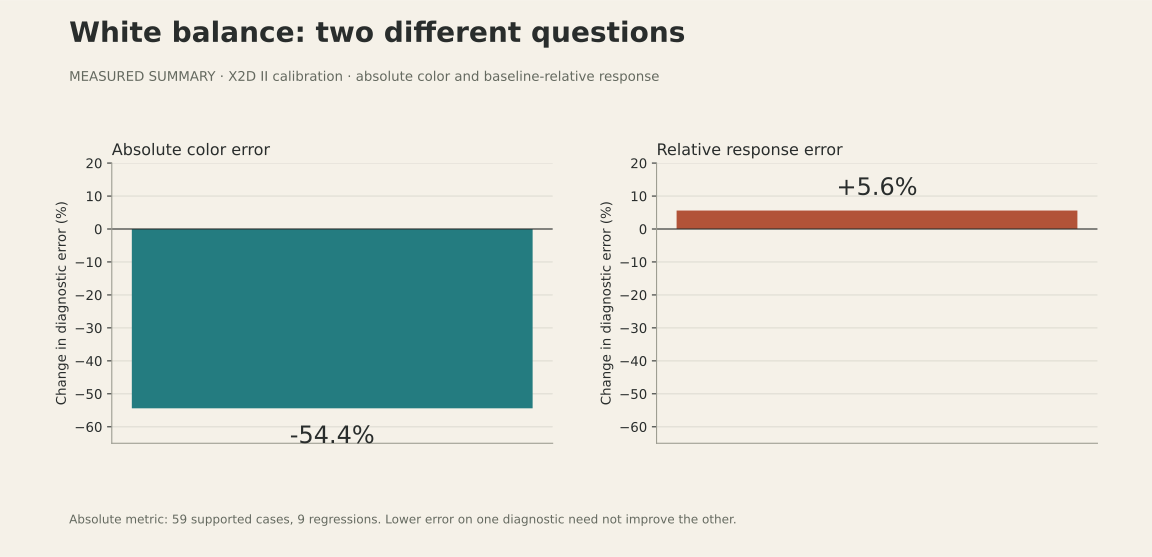
The X2D II calibration changes the effective neutral for the measured camera matrix while preserving the physical Kelvin conversion and the as-shot setting. In the recorded evaluation, absolute color error fell 54.4% across 59 supported cases, with nine regressions. Relative slider-response error rose 5.6%, so this is a demonstrated improvement to one part of white balance, with another part still unfinished.
Where you start and how you move
Imagine two controls that begin at different colors. Moving one starting point closer to the other helps the absolute comparison. It does not guarantee that turning both controls by the same amount produces the same change.
Our calibration separates those comparisons. The absolute measurement asks how far the rendering is from the reference at a setting. The response measurement asks how the edit differs from each engine's baseline. Both are useful; neither is a substitute for the other.
The camera is part of the calculation
In Chiado's pipeline, white balance operates in camera space before conversion to the working RGB space. The file's color matrix and as-shot neutral are inputs to that process. The fitted correction was therefore restricted to the specific X2D matrix it was measured against, rather than being applied to every RAW that might enter the pipeline.
We preserved the physical Kelvin conversion and the as-shot setting while changing the effective neutral calibration for that camera. The correction belongs to that camera calibration; it does not establish a model for other sensors.
What can carry over?
Some later-stage operations work on RGB rather than directly on sensor values. That makes their implementation reusable, but reuse is not evidence of equivalent results. A different camera can deliver different colors and tonal distributions to the same downstream operation.
To claim support beyond the X2D II, we would need RAWs from those cameras, verified baseline renders, varied illuminants and the same response checks. The current evidence does not justify that claim. Even within this camera, the relative white-balance response remains unfinished.
The lesson for comparing editors is to ask two questions: does this setting produce the color I expected, and does changing it behave as I expected? When the answers disagree, keeping both measurements visible is more useful than declaring a single winner.
What this changes for Chiado
The concrete benefit is a calibration scoped to the camera data it was measured against, with the original as-shot choice preserved. We keep the starting-color and slider-response measurements separate so that improving the first does not hide a regression in the second. The evidence here is X2D II-specific and does not establish support for other camera matrices.