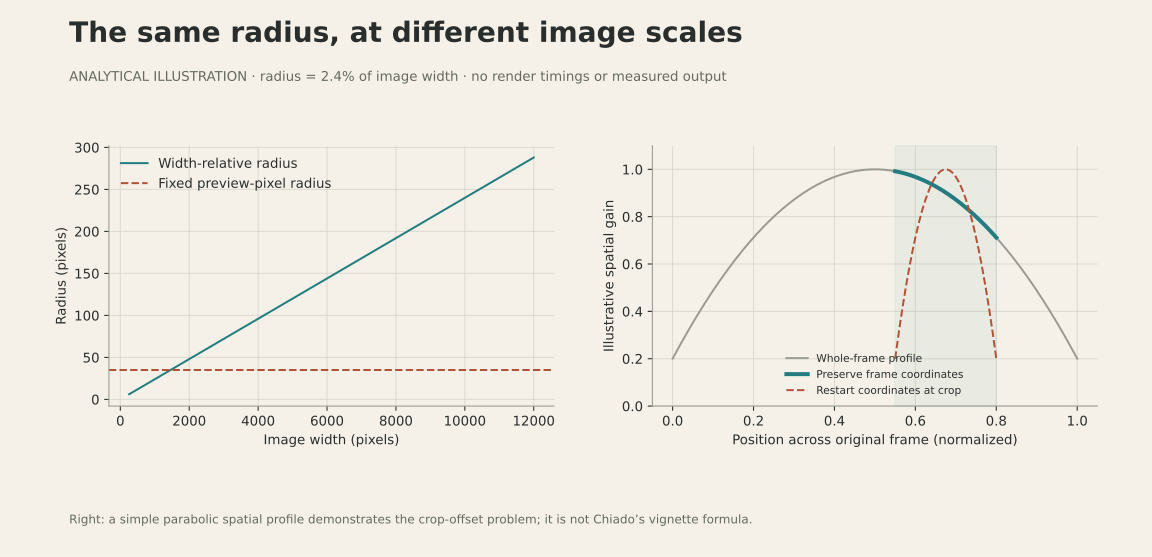
You zoom in to check a face or fine texture, make an edit, and export. The detail you judged should still be in the same place. A renderer can break that expectation even when its preview and export use the same editing formula: a crop can reset a grain pattern, a blur can change its reach, or an export boundary can introduce a seam.
Chiado carries the original frame coordinates through zoomed regions, scales local-control radii with the image, and uses shared guides for local adjustments. Its tests compare cropped renders with the corresponding parts of the full image and check that grain and vignette keep their position. Those are concrete checks on the editing experience: zooming should help you inspect an edit, rather than move it.
A radius needs a frame of reference
A blur measured as a fixed number of pixels covers a different fraction of a small preview than of a full-resolution photograph. Our local-control radii are expressed relative to image width so that their intended reach follows the photograph's scale.
That does not make the paths automatically identical. Downsampling changes detail, and rounding can matter at small sizes. Those are reasons to compare the results at relevant scales rather than assuming a width-based radius has solved the whole problem.
A crop still belongs to the whole photograph
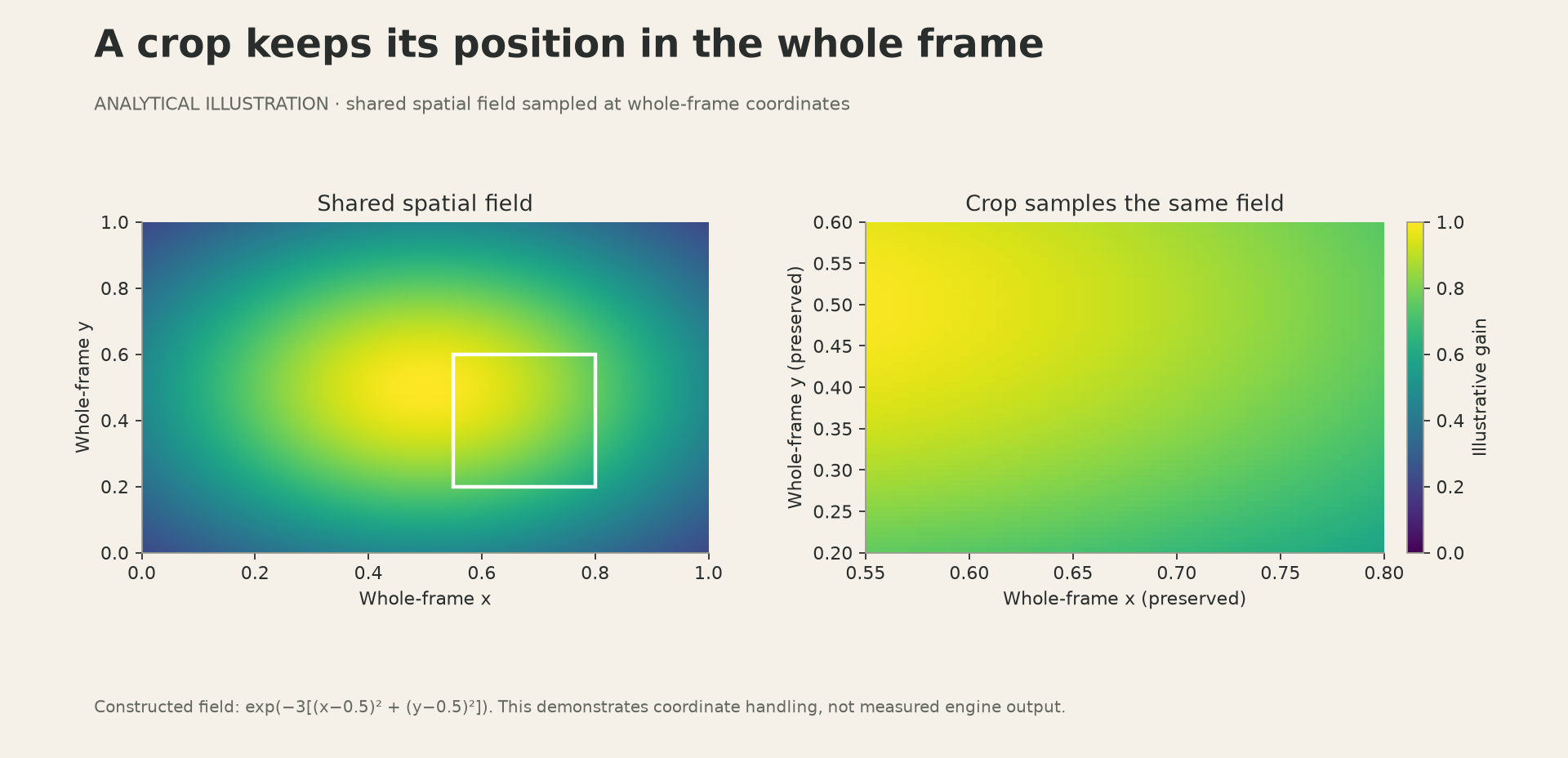
A region renderer cannot treat the top-left of a zoomed crop as the top-left of the original. A vignette, mask or grain pattern depends on location. If that location changes when the user zooms, the edit appears to move.
Our pipeline passes the region's offsets and frame information to position-dependent operations. Local adjustments sample a guide representing the wider photograph. Tests compare a separately rendered region with the corresponding part of a larger render.
Full resolution adds another boundary
The engine renders full-resolution images in bands to avoid retaining every intermediate pixel as a floating-point image at once. Local operations still need surrounding information. Independent bands with inconsistent guides can introduce seams, even if each band looks reasonable in isolation.
That is why we test different band sizes and inspect native-resolution crops. A fit-to-window image can hide a seam or a change in hair texture that becomes obvious at 100%. Conversely, a technically sharper crop does not establish that the whole photograph looks better.
Measure the experience you intend to claim
A command-line render time includes work such as reading the RAW and writing an output file. A cached editor preview has a different workload. A Mac result is not an iPad interaction benchmark, and simulator success is not proof of performance on a physical device.
For a photo editor, the useful promise is consistency: the preview should be a trustworthy guide to the result. Making that promise requires coordinate tests, scale checks and device measurements alongside color science.
What this changes for Chiado
The implemented protection is a common frame of reference across rendering paths. Synthetic tests check region/full-image agreement, including exact alignment of grain and vignette in the position-dependent effect test. Preview downsampling and rounding still need their own tolerances; this is evidence for specific consistency checks, not a claim that every preview pixel equals an export pixel.