When you select one color, the first question is which parts of the photograph will move with it. Increasing the strength of an edit cannot fix a selection that already includes the wrong colors.
Chiado’s synthetic Point Color probes separate selection from adjustment. They showed that simply widening the current selection or increasing a coefficient would not reproduce the intended comparison behavior. That finding stopped an unsupported replacement model from being adopted. It is evidence of a development check catching a problem; this note does not claim that Point Color selection is already solved.
Remove the other moving parts
We used a synthetic RAW color chart and a fixed red swatch. A Lua plugin applied explicit settings, exported TIFFs and checked the recorded settings before and after rendering. Each variant reset the previous Point Color selection and the other pinned controls. The photographic original used to construct the scratch chart was unchanged.
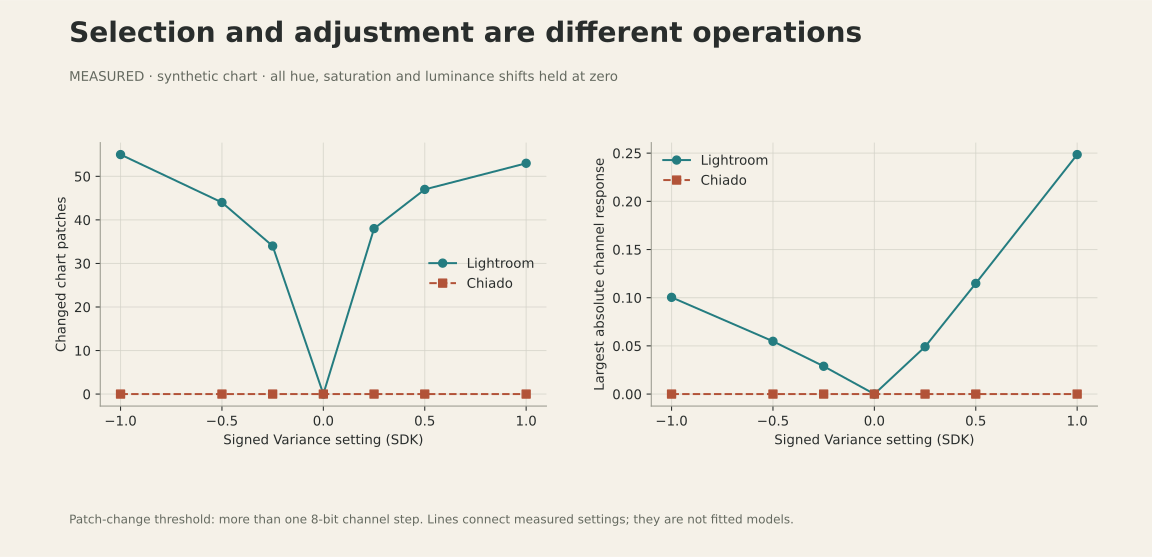
The signed Variance sweep produced the following counts. A patch counts as changed only when its mean response in at least one RGB channel exceeds one 8-bit step. These are central patch measurements, not judgments about whether an edit looks good.
| SDK value | Lightroom patches changed | Chiado patches changed |
|---|---|---|
| −1 | 55 | 0 |
| −0.5 | 44 | 0 |
| +0.5 | 47 | 0 |
| +1 | 53 | 0 |
The values shown are the normalized values submitted to Lightroom's SDK. This chart establishes that Variance performs a color operation independently of the three shifts. It does not establish the operation's formula.
Selection and adjustment are separate questions
A second mismatch appeared when we enabled a hue shift. The same nominal source HSL values selected quite different parts of the chart. Raising Chiado's Variance widened its selection far beyond Lightroom's. A larger adjustment coefficient would not solve that problem; it would make the wrong selection change more strongly.
We need to establish corresponding source-color coordinates and selection ranges before fitting the adjustment itself. Lightroom's stored swatches include separate hue, saturation and luminance range boundaries. Chiado currently has one sampled color and a simpler selection model. A similar-looking panel can conceal a different set of operations.
Keep the uncertainty in the result
Repeated zero-shift swatches also revealed a small difference despite identical recorded settings: up to 0.0023 on a 0–1 encoded RGB scale. That is below one 8-bit step, but it rules out claiming exact repeatability. The much larger Variance responses remain distinct from that difference.
A first model that moved colors toward or away from one common color did not explain the measured directions sufficiently well. As of this experiment, no replacement Point Color model has been adopted. These synthetic measurements help describe the design problem. They still need photographic validation.
The useful result was identifying which problem needed solving. Before asking how much a slider should do, test what it does when the other controls are at rest.
What this changes for Chiado
The protection here is the test that rejected the wrong kind of fix. The current model has a sampled color and a simpler selection range; the replacement still needs corresponding source coordinates, range boundaries and photographic validation. The next implementation should be judged on where it changes the photograph as well as how strongly it changes it.