Testing a photo editor should never put the photographs or edits used to test it at risk. A drive arrived during Chiado’s development with 851 RAW files, some already in the reference catalog. Importing everything again would create duplicates; changing existing records could destroy the comparison we needed to preserve.
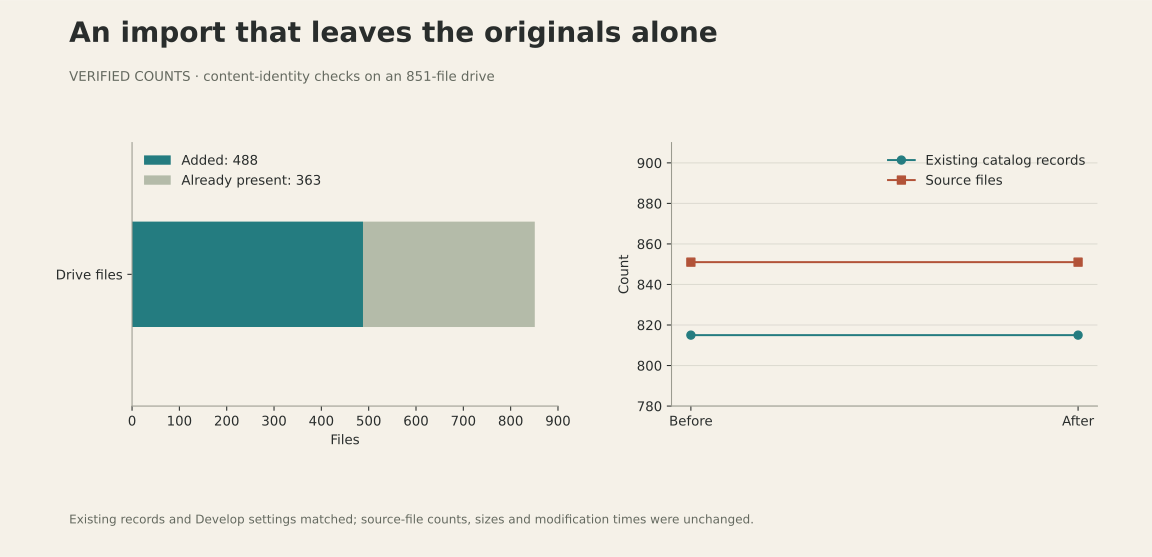
The reference-import workflow planned additions by content identity, checked the catalog’s starting state, and verified what stayed unchanged afterward. It added 488 entries, skipped 363 exact duplicates, and preserved all 815 existing catalog records and their recorded Develop settings. This was an import into the Lightroom reference catalog used to evaluate Chiado, not a test of Chiado’s in-app importer.
A filename is not a content identity
Our plan used SHA-256 hashes to identify byte-identical files. That is a stronger exact-duplicate check than matching names: a renamed copy is still the same content, while a reused name need not refer to the same file.
It is deliberately an exact check. It does not collapse bursts, visually similar photographs or separately encoded versions into one image. Those decisions require a different policy. An automated import should not quietly decide which similar photograph you meant to keep.
Make the change small enough to verify
Before importing, we captured catalog IDs, paths, ratings, flags and Develop settings, and backed up the catalog. The import request named the paths to add and required the original catalog membership to match the plan. If that starting state had changed, the request would be rejected instead of applying an outdated plan.
The operation added references in place. It did not copy the RAWs to the internal drive, move them or remove anything from the source. That distinction has a practical consequence: the external drive must remain available when the editor needs those originals. A catalog reference is not a second copy of a photograph.
Verification has a scope
Afterward, we compared every pre-existing record and its recorded edit state, counted the new entries and checked that every source still existed with the same size and modification time. Content hashes were used before import for deduplication; the post-import source check was existence and metadata, not a second full hash pass.
That wording matters. “Nothing was lost” is a broad promise. A useful report says what was checked and how. Here the import used no delete, move or edit APIs, and the before-and-after evidence matched the intended add-only change.
This workflow came from preparing photographs for Chiado's calibration. Its broader lesson is simple: plan the exact additions, preserve the starting state and verify what stayed unchanged as carefully as what was added.
What this changes for Chiado
The result is a larger reference library with its earlier edits intact, so Chiado’s next rendering change can be compared against a stable starting point. All 851 source files remained present with unchanged sizes and modification times. These checks substantiate the safety of this development operation; they do not establish duplicate detection or equivalent guarantees in the app’s own import UI.