Removing haze by pushing contrast and vibrance can make a photograph punchier without resolving the veil you wanted to remove. It can also cost detail in hair or change a sky. Chiado’s earlier positive Dehaze leaned on local luminance contrast, a black-point change and extra vibrance.
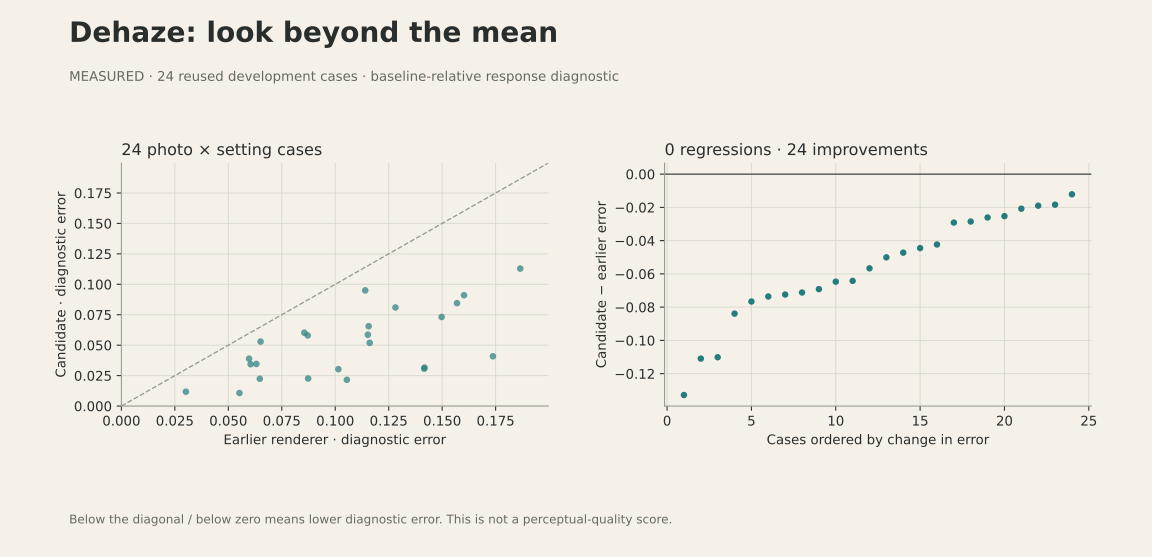
The retained revision estimates a local veil from the image and refines that guide against luminance. It reduced measured response error in all 24 reused intermediate-setting and combination cases, while 66 baseline, negative-Dehaze and unrelated-control renders stayed pixel-identical. Native crops exposed three regressions, which remain part of the result rather than disappearing behind the average.
Estimate something local
The retained experiment starts from a local minimum-RGB guide and refines it against luminance. It uses that estimate to remove a veil, with strength controlled by the slider. We evaluated this approximation against Lightroom exports and reviewed the resulting photographic crops.
The guide's size follows the image width, because the same slider should not acquire a radically different spatial reach when the image is rendered smaller. Even the rounding rule mattered: flooring a radius failed a small step-edge test, while rounding to the nearest pixel satisfied the existing assertion.
Read the regressions alongside the average
Across 24 reused intermediate-setting and combination cases, measured response error fell 52.6%, with every case improving. Six additional +100 examples averaged a 48.0% reduction, but one sky worsened. At native resolution, 18 crop-and-setting cases averaged a 55.7% reduction, with three regressions.
The crop review showed weak removal of distant haze and lost contrast in a hair crop. Those are meaningful failures even when the aggregate says the candidate is closer. A fit-to-window view cannot settle whether fine detail has survived.
A later September block gave another useful check: all 30 positive-Dehaze cases improved, averaging a 44.1% error reduction. But the scenes were event photographs, not a dedicated atmospheric-haze collection. That result supports the response comparison on those scenes; it does not prove broad performance in fog or mountain haze.
Correctness includes cost and isolation
The extra guide also costs memory and time. Mac command-line measurements including decoding and PNG writing added roughly 180–190 MB of peak memory and about 0.2 seconds. Those measurements do not tell us the latency of dragging a slider on an iPad.
We separately checked 66 baseline, negative-Dehaze and unrelated-control renders. They were pixel-identical before and after the change. That is a useful boundary: improving one side of a control should not silently alter everything around it.
The result is a retained improvement with documented weaknesses. The next useful evidence is more varied scenes and targeted failure checks, rather than another headline percentage from the same photographs.
What this changes for Chiado
Positive Dehaze now uses an image-derived guide whose spatial reach follows the photograph’s scale. The tests show a more useful response against the chosen reference on the development cases and no changes to the checked unrelated controls. Weak distant-haze removal and lost hair contrast in inspected crops remain limitations; dedicated fog and mountain scenes are still needed.